
| The Brazilian auto parts industry is expected to grow further in 2026 |
 |
While unforeseen events and reassessments of the economic scenario set the tone in 2025, there are growth prospects for the Brazilian auto parts industry in 2026, despite serious structural obstacles. This is the opinion of Carlos Eduardo Cavalcanti, economic advisor of the National Association of Brazilian Auto Parts Manufacturers (Sindipeças), who keeps track of the evolution of the automotive industry and its developments in the supply chain by delving into indicators, sector analysis, and projections. According to Cavalcanti, the increase in interest rates, which rose to 15% in the middle of the year, was at the center of debate in the industry in 2025. “The market already knew that this was going to happen, but a much more negative impact was expected,” he explains. In practice, there were different effects: the segment of heavy vehicles was the most affected, with a 12.1% drop in truck production, while light vehicles surprised with a growth of 4.5%. For the auto parts industry, the scenario was less dramatic than expected. Even with high interest rates, manufacturers demonstrated resilience, inflation was below initial expectations, and the exchange rate declined on account of capital flows to emerging economies following the “Trump effect”. Given these circumstances, companies repositioned themselves and clearly sought to become more competitive. “This trend is very likely to continue in the coming years”, Cavalcanti says. Projections by the National Association of Automotive Manufacturers (Anfavea) indicate that the automotive market is expected to grow between 3% and 4% in 2026, even with heavy vehicles still facing stagnant sales. For the auto parts industry, growth is estimated to be around 4%. In fact, there has been continuous growth in production and sales over the last five years, according to data collected by the economics department of Sindipeças. One of the major uncertainties for the future is whether the various automakers - mostly from Asia - that are setting up plants in Brazil will purchase locally produced parts. “This is a real concern. We are still not sure if this will happen, but the Brazilian auto parts industry will be more than thankful if localization efforts are put in. Nowadays, there are several successful cases of Research and Development in the industry, like automotive batteries and even electric trucks that were fully developed in Brazil and are marketed in various parts of the world”, he says. For other automotive components, Cavalcanti believes that manufacturers can fully meet the demand. “Customers need to indicate this demand, allowing for time for the learning curve. After that, the industry will rise to the challenge”, he points out. In his view, overall, there are good opportunities for the Brazilian auto parts market, because the local industry has made headway in many fields, especially when it comes to sustainable mobility. An increase in partnerships between Brazilian and foreign companies is expected within the production chain in 2026, driven by the signing of the Mercosur-European Union agreement. “This should encourage competitiveness, productivity, and the generation of more global portfolios for our companies. In this sense, programs like Mover, which foster innovation and sustainability, will play a relevant role as the growth of our industry will be closely tied to our ability to integrate more technology into local production”, he adds. 2026 is likely to be a year of adjustments, but with good prospects for the continued growth of the auto parts industry in Brazil. “Based on the facts and the studies that we have developed, this is our forecast for 2026”, Cavalcanti says. |
| Brasil Auto Parts has a full calendar in 2026 |
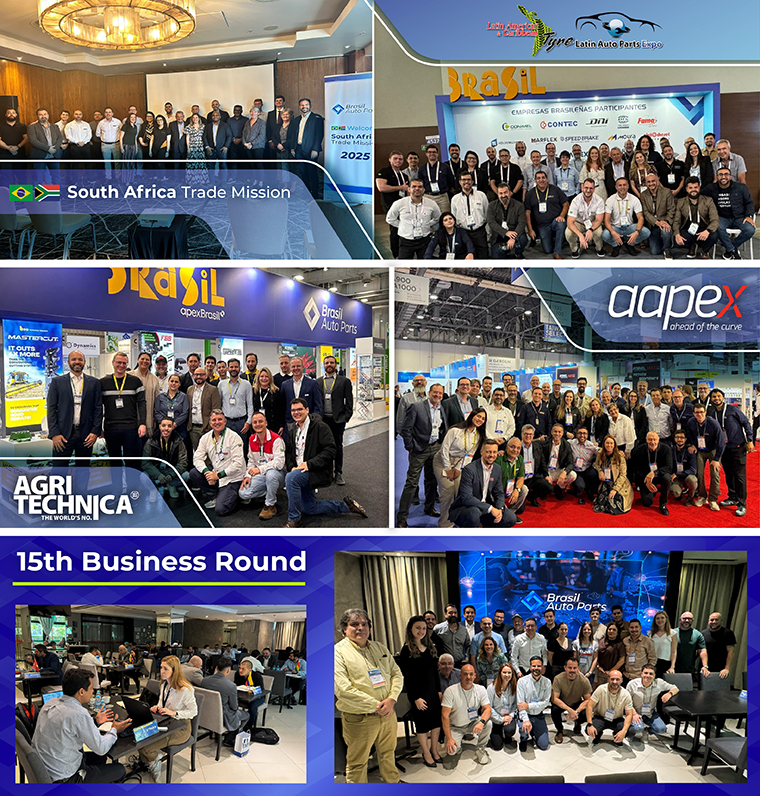 |
Brasil Auto Parts, a project born out of a partnership between Sindipeças and the Brazilian Trade and Investment Promotion Agency (ApexBrasil), signed off 2025 with significant trade promotion results for the member companies. Throughout the year, BAP-supported companies showcased their products in five international fairs and participated in a trade mission and a business round in Brazil, expanding the presence of Brazilian auto parts in strategic markets in Latin America, North America, Europe, and Africa. The activities involved countries such as as Brazil, Colombia, Germany, Mexico, Panama, South Africa, and the United States. A total of 190 companies became involved in BAP’s initiatives, which resulted in more than 3,600 business contacts. As a direct effect of this internationalization effort, the companies supported by the project had a 6% growth in exports compared to the same period last year. To attend the events scheduled in the 2026 calendar, the representatives of the member companies will travel to various destinations. One of the highlights will be Automechanika Buenos Aires, to be held from April 8 to 11 with 52 exhibitors and a side program with activities for the pursuit of business deals in Argentina. In addition to this international trade show, BAP will encourage its member companies to attend other events as exhibitors, for example, Hannover Messe (Germany, April 20–24), West Africa Automotive Show (Nigeria, May 12–14), Autopartes Medellin (Colombia, July 2–4), Automechanika Frankfurt (Germany, September 8–12), the 16th Business Round in Brazil (October), and AAPEX Las Vegas (USA, November 3-5). Fernanda Garavello, BAP’s coordinator, believes that Brazilian companies are increasingly interested in exporting their products, participating in BAP-led trade promotion initiatives more frequently, and including internationalization efforts in their strategic planning. “This strengthens the image of Brazil as a reliable supplier and means that our work is gaining recognition,” she says. Are you interested in learning more about the Brazilian auto parts industry? Visit our website and follow us on social media (Facebook and LinkedIN). |
| Tax reform can enhance competitiveness for auto parts |
 |
After a long period of negotiations, the Brazilian tax reform will enter into force in 2026. It replaces the current system of multiple taxes with a non-cumulative value-added system, namely the IBS (Goods and Services Tax ) and the CBS (Contribution on Goods and Services). Deployment will start in 2026 and extend to 2032. Its main objective is to simplify the Brazilian tax system, and companies must adapt to the new model within this time frame. The measure has direct implications for the way taxes are paid in Brazil, the so-called consumption taxes, and it will impact both domestic and international production and trade by reducing costs and increasing transparency. Edison da Matta, Legal and Tax Director of Abipeças (Brazilian Association of the Auto Parts Industry), explains that the reform brings many advantages because, over time, it will help decrease operational costs, simplify tax compliance, and reduce bureaucracy. “These results will come with time. By eliminating what is called hidden, cumulative taxes, the new system will help companies to boost their competitiveness. We have supported the reform from the very beginning”, da Matta explains. There will also be a positive impact for foreign companies purchasing Brazilian auto parts. Although international sales have always been exempted from taxation, in the previous system some embedded taxes indirectly impacted the cost of the product in the international market. Another benefit of the reform is the creation of a more transparent and safer environment for investors interested in Brazil. Edison da Matta explains that “tax simplification will create a more predictable system, which increases legal certainty. This makes the country more attractive for trade partnerships.” In short, Matta believes that Brazil’s tax reform has the potential to strengthen the national auto parts industry. “Of course, there will be the challenges of transition, but the reform will not only decrease production costs but also strengthen trade relations. This way, Brazil, without a doubt, will have the upper hand to meet international demands”, he adds. |
| “Tropicalization” is key to success in Latin America |
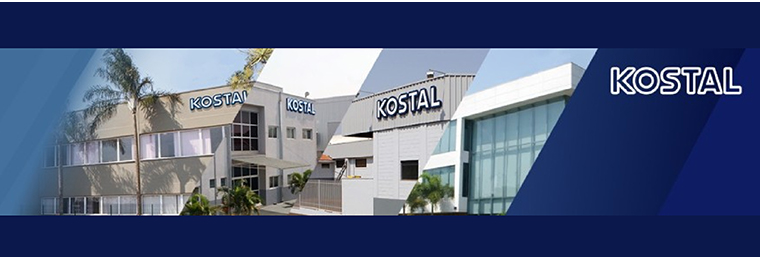 |
In this edition, you will learn how KOSTAL Brasil, a member company of BAP, and one of the 64 subsidiaries of LK, a German multinational company, managed to achieve goals and increase revenue in the Latin American aftermarket by applying management methodologies grounded on strategic planning. To face one of its major challenges, namely the installation of parts and adaptation to different fleets of vehicles circulating in the region, KOSTAL Brasil, the group’s only subsidiary that is focused on the aftermarket, needed to develop a plan to tailor solutions to this market. Although it follows the global guidelines laid down by the parent company, whose core business is the (integrated) OEM market, the Brazilian subsidiary had to adjust the product portfolio, including expert technical service to support distributors in optimizing the installation of parts and help them solve operational issues. “When the customer understands how to correctly apply the parts, we can ensure good part-product performance, which builds loyalty and strengthens our relationship”, says Ana Carolina Costa, Sales and Marketing Manager in the aftermarket segment. The company also focused heavily on digital expansion, developing more complete and robust catalogs, and increasing its presence in international events organized by BAP and on platforms such as Mercado Libre. To achieve its goals, it undertook several sales promotion initiatives and set up shop in key countries such as Brazil, Colombia, and Argentina. This strategy resulted in a growth in sales, especially in the aftermarket segment. “In 2025, KOSTAL’s exports accounted for 15%-20% of its revenue. And our goal is to keep growing”, Costa says. What also ensures the company’s success in Brazil and in international markets alike is the fact that it monitors its sales, capillarity, and revenue goals on a regular basis. “Our management practices allow us to correct routes when necessary and give us a broader view of the whole process”, she explains. In short, the “tropicalization” of planning was a key point and exemplifies how a deep understanding of the specific demands of a particular region, combined with a well-executed strategic plan, can produce positive results and promote sustainable growth. “2025 was very positive and marked by exponential growth as we are committed to understanding our customers and their needs. Now we must keep focused and follow this path”, she says. |
| The Mercosur-EU agreement was signed, creating one of the world’s largest free trade areas |
|
|
|



| To ensure that our communications reach your inbox, add the email address [email protected] to your address book. Follow Brasil Auto Parts on Facebook and Linkedin. |